AI Ethical Impact Assessment (EIA) Playbook & Toolkits – Adapting Global AI Ethics into Real-World Practice in Thailand"
- IT Harmonyx
- 5 days ago
- 2 min read
Bangkok, 30 June 2026 – On the second day of AI Governance Week 2026 (AIGW 2026), the focus shifted from high-level policies to actionable risk management. To ensure AI systems are not only efficient but also safe and equitable, ETDA officially introduced Thailand’s draft Ethical Impact Assessment (EIA) Playbook, adapted from the UNESCO Recommendation on the Ethics of Artificial Intelligence, providing a critical tool for organizations to evaluate AI risks before real-world deployment.
The sessions featured in-depth discussions with experts from UNESCO, UNICEF, and ETDA, outlining how organizations can systematically bridge the gap between global ethical principles and practical implementation.
The UNESCO EIA: Moving Beyond System Efficiency
Dr. James Wright from UNESCO and Dr. Sak Segkhoonthod from ETDA highlighted a crucial shift in perspective: AI governance must ask deeper questions. It is no longer enough to measure how fast or accurate an AI system is. Organizations must evaluate who will be affected, how they will be impacted, and who is accountable if outcomes are unfair or unsafe. The UNESCO EIA framework serves as a bridge, ensuring that core values such as explainability, fairness, and data protection are integrated into AI projects, particularly in high-impact areas like targeted welfare and financial services.
Launching Thailand’s First EIA Playbook
Mr. Thitikorn Trakulsirisak, AIGC Expert at ETDA, presented the operationalization of these concepts through Thailand’s first EIA Playbook. The playbook guides organizations to view AI not just as a "model," but as a complete system involving data, processes, and societal impacts. Organizations can assess AI across three key components:
Scoping Questions: Defining the AI use case, its objectives, and identifying accountable parties.
Principles-Based Questions: Evaluating systems against core principles like safety, privacy, human oversight, and transparency.
Impact Mapping: Analyzing potential positive and negative impacts to establish effective mitigation measures. EIA is not a one-time checklist but a continuous, collaborative process that must be revisited whenever an AI system's context or data changes.
Safeguarding the Next Generation
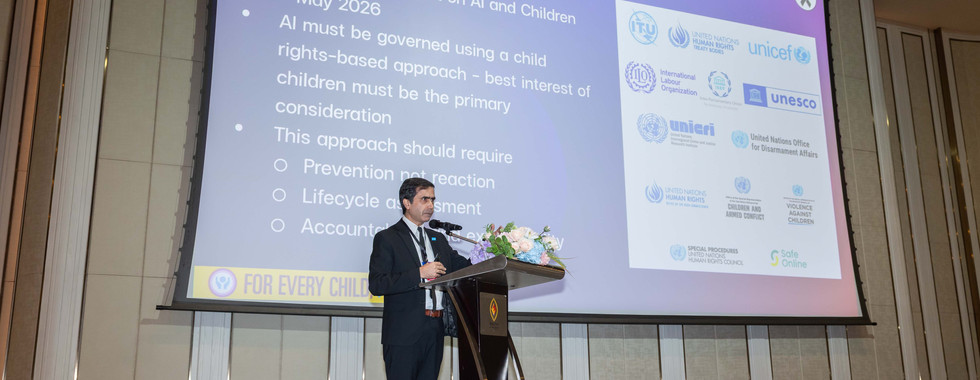
Mr. Muhammad Rafiq Khan of UNICEF brought a critical perspective to the table: "Children are not small adults." Children have distinct vulnerabilities and greater exposure to AI impacts through learning platforms, games, and social media. Utilizing the OECD's 5Cs framework (Content, Contact, Conduct, Contract, and Cross-cutting risks), the session emphasized that AI can act as a "risk multiplier." Assessing AI's impact on children is not an optional step; it is a fundamental requirement to ensure digital environments are age-appropriate, privacy-protective, and completely safe.
The unveiling of the EIA Playbook marks a significant milestone in Thailand’s AI journey. It empowers Thai organizations to assess before they deploy, identify risks before they become harms, and design AI systems with built-in accountability and public trust.















Comments